
ENGINEERING INSIGHTS
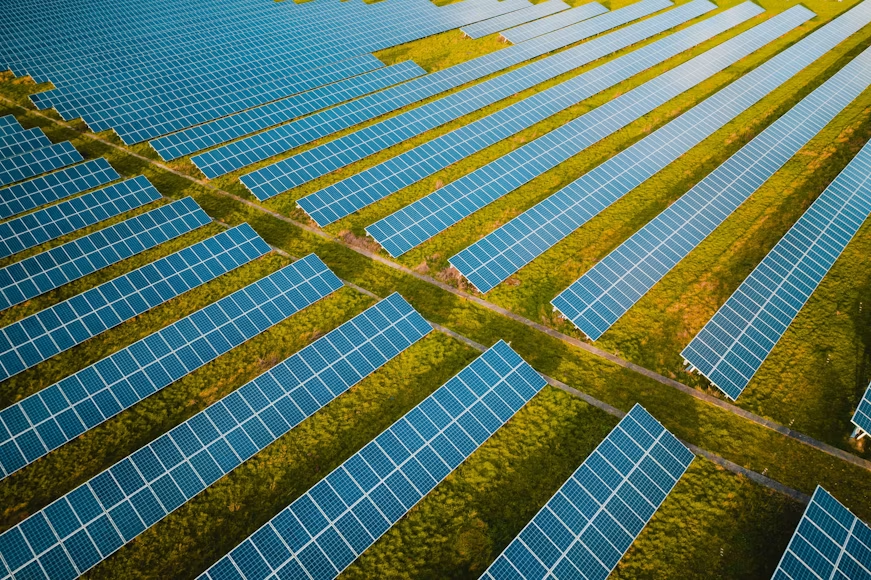
Bangladesh needs cheap, reliable power, and fast. For years, the country has leaned on imported gas and diesel. That's why power costs so much here. In fact, every time gas prices rise, the budget feels it. But there's good news too: Bangladesh gets great sun. Most of the country sees 4.5 to 5 peak sun hours a day, which is some of the best sun in South Asia. That's exactly why the utility scale solar power plants solution in Bangladesh has grown fast in just two years. So, this guide covers how these plants work, why they matter, and how to build one.
People use this term loosely, so let's be clear. A utility scale solar power plant is a big solar farm. It links to the power grid, and it sells power to the grid, not to one home or shop. Generally, most countries call a plant "utility scale" past 1 MW. However, that's not quite how the utility scale solar power plants solution in Bangladesh works. Most local plants fall between 10 MW and 200 MW.
Two other setups are worth knowing, just to see how this one differs:
Rooftop or captive solar. A shop or factory adds panels to cut its own bill.
Off-grid or mini-grid solar. This is common in villages with no steady grid link.
By contrast, utility scale plants sit on open land. Builders need about 3 to 5 acres per megawatt, and they link the plant straight to a substation. Then, a state buyer buys the power. In Bangladesh, that buyer is almost always the Bangladesh Power Development Board, or BPDB. Overall, the deal runs under a long power deal, called a PPA.
Land shortage, funding gaps, and slow sign-offs held back solar here for years. That's finally changing.
By early 2026, renewables gave Bangladesh about 1,700 MW of power, with solar making up most of that (source). That's still a small share, but the pipeline has grown fast. Earlier this year, for instance, BPDB signed deals for seven solar projects worth 523 MW combined. Then, by April, the government opened a new tender for 77.6 MW more. This followed a bigger tender the year before, worth 2.65 GW, which was the biggest solar tender in the country's history.
Meanwhile, groups in the industry see solar as key to a bigger goal too: 10,000 MW of solar power by 2030. One study backs this up, expecting Bangladesh's solar power to grow more than sixfold in ten years. Specifically, that means a jump from about 1.3 GW in 2025 to about 8.5 GW by 2035. As a result, big grid-linked plants will drive most of that growth, while small rural systems will play a smaller role than before.
A few recent moves show this shift in action:
Under the new deals, teams are building plants from 10 MW to 200 MW in Chittagong, Bogra, Nilphamari, and Noakhali. Each plant will feed the grid for 20 years once it starts.
Similarly, BPDB is also planning the country's biggest solar plant yet. It's a 442 MW site near the Rampal Power Station, covering about 685 acres, at a cost of roughly $200 million.
In addition, the government also made a new rule that opens public land to solar builders, with BPDB acting as the deal-maker.
Altogether, that last point is a big shift. After all, land has long been the top block for solar builders here, in a crowded country. Therefore, opening public land clears one of the biggest blocks almost overnight.
The money side has shifted fast. Specifically, Bangladesh used to strike deals government-to-government, but now it runs open bids instead. As a result, that has pushed prices down, and solar now costs about USD 0.04 to 0.05 per kilowatt-hour. This is a sharp drop from a few years back, and it's below the cost of running an oil or gas plant.
Likewise, gear costs have dropped too. Solar panels are in oversupply worldwide, and newer, more efficient panels keep hitting the market. Consequently, build costs for big plants have fallen to around USD 600 to 800 per kilowatt. For a 50 MW plant, therefore, that's a build cost near USD 30 to 40 million, before land and loans. These numbers, in short, make solar a real match for new gas plants, even before you count how much gas prices swing.
There's a climate case here too. For example, take one 20 MW plant funded by the Asian Development Bank. It will make close to 38 gigawatt-hours of power each year. It will also cut over 18,000 tons of carbon a year, about what a few thousand cars would save in a year. Now, multiply that across a pipeline of several hundred megawatts. The climate case, as a result, is hard to ignore, especially for a country as exposed to climate risk as Bangladesh.
Most builders follow the same basic steps for a utility scale solar power plants solution in Bangladesh. This holds true whether the plant is 10 MW or 400 MW. Therefore, knowing these steps helps any group plan its move into this market, including government bodies, private investors, and factory owners alike.
Picking the site is, hands down, the biggest choice in the whole project. First, teams check sun strength, called Global Horizontal Irradiation, along with flood risk, wind risk, and land access. In Bangladesh specifically, flood risk and rain drainage matter more than usual, since the land here is flat and low. As a result, this is often where a local builder beats a foreign template.
Before any build starts, teams run a study. This study checks likely power output and grid links, and it also flags risk for banks and backers. In addition, this step covers environment checks and early funding talks as well.
Next comes the detailed design work. This covers panel layout and mount type, either fixed or tracking, along with inverter and transformer specs. This step also makes the wiring maps that show how the plant links to the grid. Notably, choices made here shape plant output for over 20 years — panel type, inverter design, and cable size all matter.
In Bangladesh, this step needs sign-off from BPDB, and some sites also need sign-off from the Power Grid Company of Bangladesh, or PGCB. Locking in a firm grid link early, therefore, saves builders from costly redos later. This matters most in the north, where grid limits have already caused real power cuts (more on this below).
At this stage, teams order panels, inverters, transformers, and mounts. Then comes civil work, machine build, and wiring. Typically, for a 50 MW plant, build time runs 8 to 12 months from groundbreak to grid link. This assumes land and permits are already sorted.
Once the plant passes grid tests, it starts selling power under its deal, usually a 20-year term in Bangladesh. From here, good upkeep becomes the key factor that decides whether the plant hits its full 25-year output goal.
Here's a snag that doesn't get enough airtime: the grid hasn't kept up with new plants in every region. In fact, plants in the north now lose 15 to 20 percent of midday output. This happens simply because substations haven't caught up with new solar builds. In plain terms, some plants must cut power at peak sun hours, because the grid just can't take it all.
This isn't a reason to skip the utility scale solar power plants solution in Bangladesh. Rather, it's a reason to plan grid links early. The Power Grid Company of Bangladesh has set aside about USD 1.2 billion for grid upgrades through 2028, which should ease the strain over time. Still, any project closing a deal in the next two or three years needs a real grid study. That study must check actual regional grid room, not just numbers on paper. Skip that step, and you may find out too late that your site can't send out full power.
Grid planning, therefore, should never be an afterthought at the end of a project. Instead, it belongs at the table from day one, right next to site choice.
To illustrate, a few live projects show what this shift looks like on the ground.
In Nilphamari, for instance, one team is building a 50 MW plant, deliberately picking a spot close to an existing substation. Smart move, since a plant near strong grid links cuts both cost and power loss risk. Similarly, in Chattogram division, another team is building a 45 MW plant in Fatikchari. A third group is building an 18 MW plant nearby in Hathazari.
Public land is entering the mix too. Specifically, the Bangladesh Economic Zones Authority has moved ahead with a 130 to 140 MW plant in Sonagazi, Feni. Teams will build it on state-owned land, under a public-private deal. This pairing makes sense, in other words, because it puts solar power right next to factory zones that need steady daytime power.
Furthermore, foreign money is flowing in too. In one deal, a large Chinese state firm formed a 100 MW venture with a local partner. The project sits in Jamalpur. This shows a wider trend: foreign builders often team up with local firms that know how to handle land deals and grid rules on the ground. After all, no foreign standard can fully replace that local know-how.
Before you commit to a solar project in Bangladesh, ask these questions. They tend to split deals that close from those that stall.
Is the land title clean, and is the site outside flood zones? Land trouble stalls more projects than anything else.
Is grid room confirmed at the link point? Don't trust a map. Get real proof.
Does the builder have a track record with BPDB's rules? Bangladesh's grid code has its own steps. These differ from global norms.
What funding mix works best? For example, many recent deals blend public funds with private cash. The Rampal project, for one, will draw about 15 percent from BPDB's own funds, while the rest comes from a state power fund.
Does the power price still hold up? Prices have dropped fast in the past two years. Old numbers may no longer apply.
Ultimately, these aren't small points. Rather, they mark the line between a deal signed on paper and a plant that runs for real. That's a full 20 years of power.
In short, the path ahead looks clear. Bangladesh is moving from a few early solar projects to a real pipeline of big plants, backed by government rules, foreign funding, and lower tech costs. Admittedly, the 10,000 MW goal for 2030 is a stretch, and grid upgrades will need steady cash to keep up. Still, the core case for solar now adds up: strong sun, low prices, and better rules.
So, is now the right time to jump into the utility scale solar power plants solution in Bangladesh? Honestly, the answer is yes. The window is open right now, and good land, cheap panels, and strong BPDB ties matter more before the market gets crowded. However, that window won't stay open forever.
If you're weighing a utility scale solar project in Bangladesh, from first study through grid-linked power sales, Gtech Infrastructure's utility-scale solar power plant solutions cover the full build process. That means site checks, design, sourcing, construction, and long-term upkeep. Every step is built around how Bangladesh's grid and rules actually work.
view more
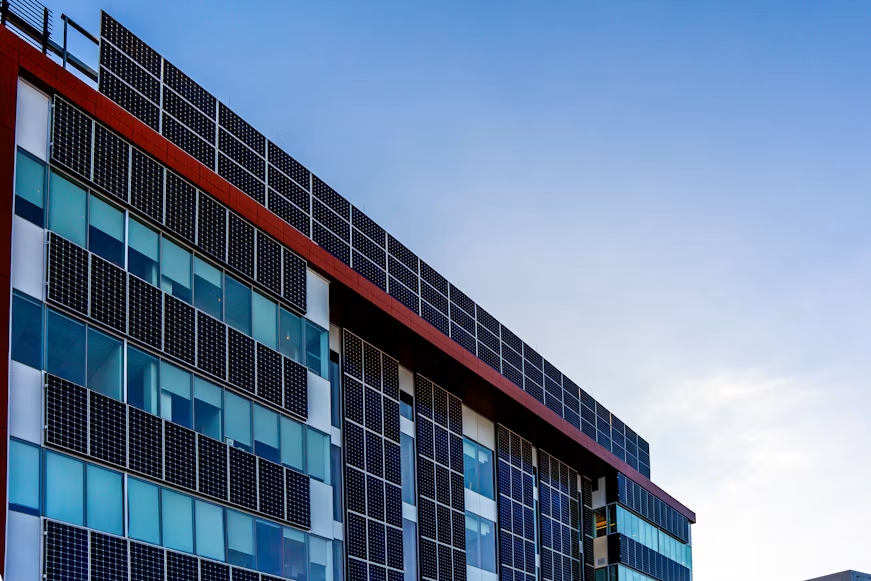
See how the BIPV solution in Bangladesh works, what it costs, and why architects and developers are starting to take notice.
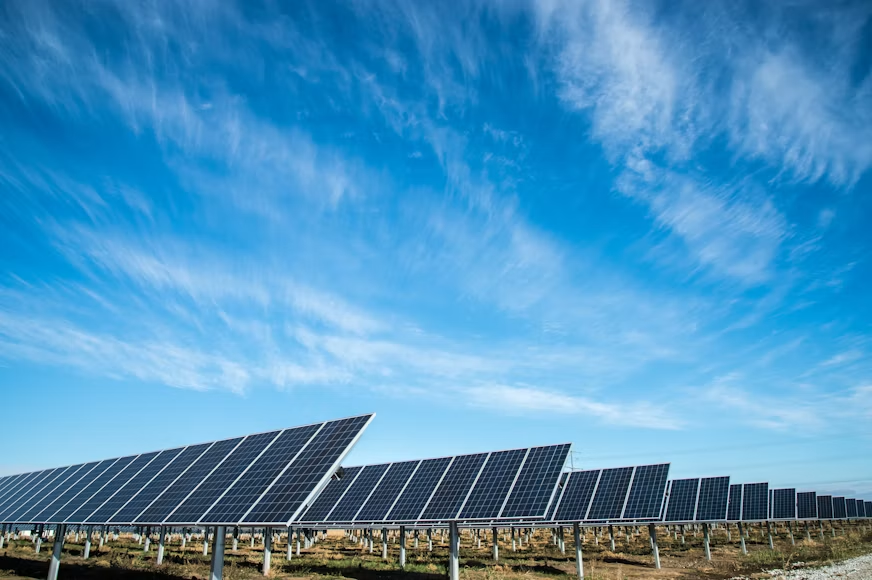
Looking for a solar EPC company in Bangladesh? See what EPC means, what to check, and why a solar EPC company in Dhaka often has the edge.
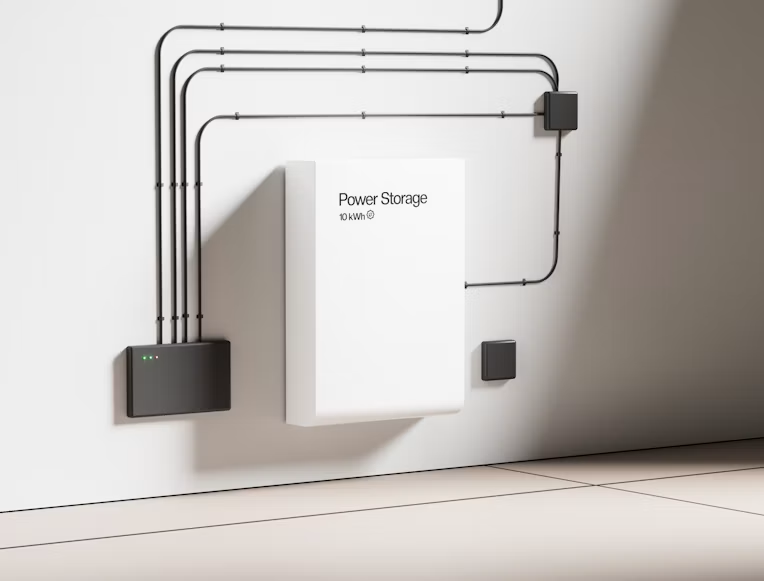
See how the battery energy storage solution in Bangladesh works, what it costs, and why factories are switching from diesel.

Need help choosing?
As land-use pressure increases across Europe, Agri-PV is becoming an increasingly relevant solution.


Rapid Response

Expert Guidance at Every Step

Support